
What We Design to Encourage and What We Still Enable
My first conference, attending on my own and in a state where I have limited connections, proved much easier than I expected. My biggest takeaway wasn’t necessarily from the technical learnings of traffic engineering, but from seeing how willing people at all stages of their careers, and across all areas of the traffic and transport industry, were to make new connections and share their experiences. The conversations gave me plenty to reflect on — the things we’re doing well, the areas where we still have room to improve, and the questions or considerations that may not even be on our radar yet, but perhaps should be.
Hearing different perspectives from across the industry challenged me to think beyond the technical side of engineering, which can sometimes become a tick-box compliance exercise, and consider the broader impact of the work we do. Day-to-day, it’s easy to forget to stop and really look at — and critique — the places we move through. One of my highlights was the Springfield site tour. There was something particularly interesting about seeing a master-planned city where health and research have been considered as part of the everyday principles that shape how the community is designed and functions.
It also got me thinking about how intention translates into reality. Springfield has attractive walking routes and provides people with alternative ways to move around the city, but large areas of car parking remain readily available and convenient. Even where the long-term vision may be for these areas to be developed over, the infrastructure we provide today can still shape habits and expectations well into the future. If driving remains the easiest and most familiar option, how much can alternative infrastructure alone shift behaviour once those habits become ingrained in a community?
This brought me back to my overarching thought: what we design to encourage, and what we still enable. There is a difference between simply providing infrastructure and designing an environment with the intention of influencing behaviour. Mode shift was a major theme of the conference at a city-wide level. But for me, working at a more granular level on individual developments, it raises a bigger question: How do we shift the mindset of developers from simply ticking the box to genuinely delivering better outcomes for the city?
The disconnect between vision and reality is still prevalent across the industry. While policy sets the minimum standard, meeting that minimum cannot be the only measure of success if we are serious about driving better transport outcomes. Real change happens at the granular level — through the decisions made on individual developments, and through our willingness to challenge what is considered “good enough.”
For example, a 1.5-metre footpath might satisfy a requirement, but does it create a genuinely attractive and connected pedestrian experience? If driving remains the most direct, attractive and prioritised option within the road corridor, can we really expect the addition of a footpath, cycleway or public transport connection on its own to shift behaviour? The infrastructure may be there, but the outcome can be very different depending on how the broader environment is designed.
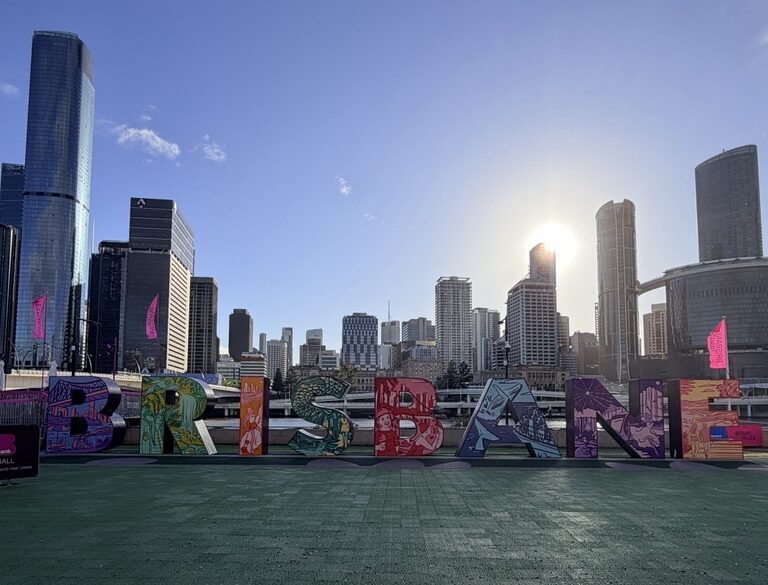
These questions became an even bigger focus throughout the conference discussions around the Olympic Games and the lasting legacy that transport infrastructure can leave for the city of Brisbane. It was a great reminder that the decisions we make today can shape how people move, connect and experience a city long into the future.
I’m heading back to work with a new lens and a fresh perspective for learning — and a much greater appreciation for the people, conversations and experiences that shape our industry.