
Traffic Assessments

A Traffic Impact Assessment is often required to support development applications. We have reviewed the traffic and transport implications of a wide variety of projects and specialise in the preparation of these documents. The process typically involves:

• Undertaking a site inspection;
• Commissioning traffic and parking surveys of the area;
• Liaising with the relevant road authorities;
• Conducting a review of the car parking and access arrangements against relevant standards;
• Preparing swept path assessments using the latest computer software;
• Providing advice regarding the provision and design of parking;
• Calculating the traffic generation of the site;
• Carrying out traffic modelling using SIDRA to assess the impacts of the traffic generated by the site;
• Reviewing the service vehicle and waste collection arrangements; and
• Providing advice regarding pedestrian and cyclist facilities.

Click the button below to read about some of the projects we’ve prepared traffic assessments for, or contact us on 1800 022 363 for help with your next project.

Dubbo Mixed Use Subdivision

Amber has completed a Traffic Impact Assessment report for the proposed mixed use subdivision adjacent to Narromine Road in Dubbo. The project represents a significant addition to the Dubbo township, proposing approximately 2,000 residential lots, 40 hectares of industrial and commercial land, and a new shopping centre. The Traffic Report provided a traffic modelling assessment using SIDRA to determine the traffic impacts of the project on the surrounding road network and the required road upgrades and intersection treatments. We worked closely with the relevant disciplines in the team to ensure the subdivision is designed sustainably to allow for alternative transport modes. The report is to be used to support the masterplan and a range of Planning Proposals and Development Applications for the various stages.

An Assessment of Gymnasium Parking Rates in the TfNSW Guide to Traffic Impact Assessment

The parking provision for many land uses can often be one of the most challenging components of the Development Application. The TfNSW Guide to Traffic Impact Assessment (TGTIA) covers a wide range of land uses but the guide’s generic categories often fail to reflect how differently these facilities can operate in practice. Amber’s experience with gymnasiums has shown that even when the TGTIA covers your land use, the development’s unique operating model means that bespoke assessments are essential for accurate traffic and parking outcomes. A parking rate for gymnasiums, which is a generic term which would cover many different forms of training, is provided yet only for facilities within a centre near rail/bus services. The rate is three spaces per 100 square metres (sqm) of ground floor area (GFA).

The gymnasium category is broad to accurately capture parking demands associated with different types of gyms. A weight training gym typically operates with continuous patron arrivals through the whole day with peaks in the morning and the afternoon/evening. In contrast, a fitness studio offering classes will experience an influx of arrivals and departures at class change over times followed by periods of no arrivals. Furthermore, fitness classes may not operate at all outside of the peak periods associated with weight training gyms. With such different operational models, it would not be appropriate to apply the same parking rate to every type of gymnasium.

Amber Case Studies: Weight Training vs Fitness Studios

Two business models recently assessed by Amber were a weight training gym with a GFA of 920 sqm and a small group training studio with a GFA of 241 sqm. The parking requirement for each gym to comply with the TGTIA recommendations would be 28 spaces and 8 spaces, respectively. Our study revealed the following car parking requirement:

The weight training gym was relocating from a smaller site approximately 600 metres away. Therefore, we were able to undertake a parking demand and travel mode survey to ascertain the existing travel and parking behaviours of the current members. The patronage reached 118 patrons in one day, with 85% of them driving a vehicle to the site. There was a peak parking demand of 12 spaces at 7pm. After scaling the results up to the proposed larger gym, we get a peak parking demand of 16 spaces.

An empirical assessment of the parking demand associated with the fitness studio was used to estimate a reasonable number of parking spaces required by the business. Based on our experience and a review of survey data with other similar developments it is expected that the patrons would generate a parking demand of approximately 0.8 spaces per patron. This rate allows for some level of car-pooling or use of alternate transport modes. With class sizes capped at 15 participants and two staff members, this equates to a parking demand of 14 spaces.

See how the difference in operating model, gymnasium size and parking provision compares:
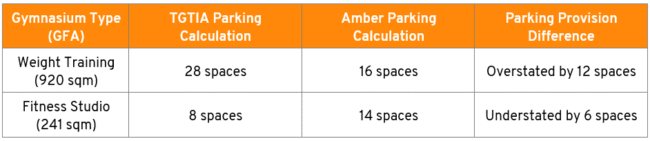
The results of our parking assessments show vastly different results to the TGTIA recommendation for each gymnasium. The large weight training gym has an overstated parking demand of 12 spaces and the small fitness studio is understated by 6 spaces. It should also be noted that both gyms have a very similar parking demand despite their size and operational differences.

Gymnasiums vary widely in their operational characteristics and the one parking rate approach will often not result in an accurate parking provision. Amber’s experience in this area has shown that each development requires a thorough study to demonstrate the likely parking demand associated with the business. It is very important to understand the operational model being proposed to provide the confidence to the application assessors that the proposed business will provide a suitable parking solution for their customers and not adversely impact the parking conditions in the surrounding area.

Middlebrook Solar Farm

Amber has recently completed a Traffic Impact Assessment for the 500MW Middlebrook Solar Farm, which is one of the largest solar farms in the country. The project involved extensive consultation with the relevant road authorities in order to gain prior approval for the proposed access arrangements of the site. Amber prepared concept designs for intersection upgrades and conducted a review of the traffic impacts of the proposal on the surrounding road network. This continues are extensive involvement in the renewable energy sector.

Oran Park Subdivision

Amber Organisation has recently completed a number of Traffic Impact Assessments for various residential developments within the Oran Park growth area. We regularly prepare traffic reports for subdivisions within the South West Growth Areas. Our assessments provide a review of the potential traffic impacts of the project including the use of traffic modelling software such as SIDRA. We also provide advice on the road layouts to ensure streets and walking and cycling facilities connect with the wider area, as well as a review of the road design itself to ensure vehicles can safely and efficiently travel within the site.

Hallam South Warehouse

We prepared a Traffic Impact Assessment for a large warehouse in Hallam South. The access for the project was assessed against the turn treatments of the Austroads Guide which were subsequently unable to be provided due to the constraints of the existing road network. Through our liaising with Department of Transport we were able to prepare a functional layout plan that still provides a safe road environment and worked with our partners to provide a Road Safety Audit.

Land and Housing Corporation

LAHC is working to redevelop and transform the former Claymore and Airds Bradbury social housing estates in Campbelltown. Amber has prepared a number of Traffic Impact Assessments within these concept plans, including an assessment of the various stages of the subdivision and assessments of individual seniors living buildings. The assessments require careful consideration of the changes to the surrounding transport network and active transport facilities to ensure the developments create a well-connected street network. We provide design advice and prepared swept path diagrams for the car park layouts to ensure they are suitably designed for the end user. We are proud to work on social housing projects supporting some of the most vulnerable people in our community.

Wagga Wagga Place of Worship

We have prepared a Traffic Impact Assessment for a 100 patron place of worship in Wagga Wagga. The primary challenge with these projects is providing sufficient car parking to accommodate the typical parking demand for the proposed use. We worked closely with our client to determine what a suitable level of car parking would be based on survey information collected from similar sites they operate. We also provided a review of key religious holidays that generate more patrons and any potential off-site parking impacts. Our assessment included a design review of the car parking area which was checked against the Development Control Plan and Australian Standards, and a swept path assessment was prepared.

Wanderer Music Festival

Wanderer is a new multi-day music festival which first operated in September 2022. The festival is held on farm land approximately 6.5 kilometres north of Merimbula and has a capacity of 14,000 patrons including 10,000 camping patrons. Amber prepared a Traffic Impact Assessment for the project which assessed the potential traffic impacts on the road network. We also provided a review of the proposed operation of the site to ensure patrons were able to access the site in a timely manner and to identify ways to encourage the use of the alternative transport options.

McCall Gardens

The McCall Gardens subdivision proposes a mixture of low to high density residential and commercial land use. The subdivision is expected to accommodate approximately 1,205 dwellings on-site and included a substantial redevelopment of the existing Ross House Community Hub. Amber prepared Traffic Impact Assessment reports for the various stages of the subdivision which reviewed the potential traffic impacts of the project and the design of the road layout. We also provided an assessment of the proposal for the Ross House Community Hub including the preparation of swept path diagrams for the car park layout, a review of the access and parking design against the requirements of the Australian Standards, and a review of the parking provision for the various uses.

Williamstown North Warehouses

Amber has completed a number of warehouse developments within a new industrial subdivision located in Williamstown North. Through our collection of data for similar developments we understand that the warehouse parking rates outlined within the Planning Scheme are overly onerous for smaller warehouse tenancies. We have extensive experience throughout Victoria justifying a reduction in the Planning Scheme parking requirements. We also understand the heavy vehicle requirements for these projects and can assist in designing the loading areas to reduce the truck manoeuvre area, increasing your building footprint.

Traffic impact assessment services icon - Amber Org

Traffic Assessments

Parking Requirement and Design icon - Amber Org

Parking & Design

Intersection modelling icon - Amber Org

Intersection Modelling

Constructuction Permit Expert Witness Icon - Amber Org

Expert Witness

Road infrastructure geometric design icon - Amber Org

Geometric Design

Construction Traffic management icon - Amber Org

Traffic Management Plans

Wind and solar farms traffic studies or documentation icons - Amber Org

Renewable Energy

Construction and development master plans icon - Amber Org

Master Plans

Amber Organisation Logo & Tagline - Traffic Engineers and Transportation Planners

Amber Organisation acknowledges the Traditional Owners of Country throughout Australia and recognises the continuing connection to lands, waters and communities. We pay our respect to Aboriginal and Torres Strait Islander cultures; and to Elders past and present.

Talk to an expert

We're here to help and answer any questions you might have.
We look forward to hearing from you.

Email:    info@amberorg.com.au

Phone:   1800 022 363

Visit us on LinkedIn