
I am proudly a bicycle commuter. I recently sold my vehicle and opted to rely heavily on my trusted two-wheeled companion or begrudgingly take public transport when the weather (or sometimes distance) demands it. I am lucky to live close to the city in a large apartment building and Amber’s office is well equipped with shared end of trip facilities. Though over the two years of daily commuting to the office, I have noticed something. Bicycle parking has not evolved to accommodate the rise in popularity of eBikes.
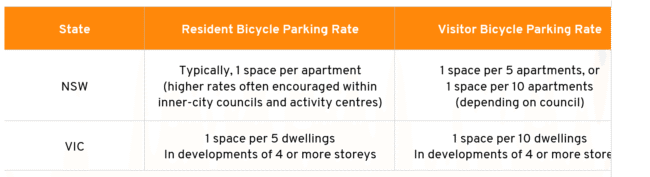
Did you know that there is usually a requirement to provide bicycle parking in large residential developments and with many land uses that may attract bike riders? The requirement to provide a bicycle parking provision is generally set by individual council Development Control Plans (DCP) in NSW and by the State under Clause 52.34 of the Victoria Planning Schemes in Victoria. Given the parking rates are set at a local level in NSW, they can vary, while Victorian rates are consistent state-wide. The current rates for residential dwellings are:
Full Victorian bicycle parking requirements can be found in this article by Amber.
Adequate bicycle parking provision is one thing, providing usable facilities is another. The DCP and Planning Schemes often stipulate the facilities should be designed as per the Australian Standards (AS 2890.3:2015 Parking Facilities, Part 3 Bicycle Parking). The Australian Standard lists the following requirements for bicycle parking facilities designs:
- Safe for all user types, secure and conveniently located;
- Accommodate and support standard bicycles with sufficient space to minimise damage while parked and during movement in/out of the parking space;
- Suit the particular location, e.g. off-street, on-street, within buildings;
- Facilities do not obstruct or hinder pedestrian access ways, bus stops, loading zones, post office boxes, public telephones, public help access points, taxi ranks, fire hydrants, fire escapes, traffic signals, and areas adjacent to accessible car parking as required by AS/NZS 2890.6; and
- Include a minimum of 20% of ground level (horizontal) bicycle parking device (BPD) in any bicycle parking facility (for those riders unable to lift a bicycle to a hanging BPD and for parking of non-standard bicycles).
Note the one consideration for non-standard bicycles, which by definition includes eBikes.
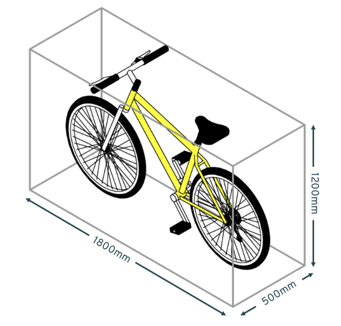
The Standard goes on to detail what is a bicycle spacing envelope. The envelope considers the parking space in three dimensions as shown below. Additionally, BPDs would need to be spaced appropriately to allow easy access to bicycles. For instance, bicycle racks should be spaced 1 metre apart.
EBikes vary from standard bikes in a number of ways. They are typically much heavier (20–35 kg vs 12–18 kg), have larger frames as well as some having cargo-bike variations, have higher theft risk due to their value and also have charging requirements. Due to these variations, provision of suitable BPDs is crucial to support their rise in popularity in the future and ensure they do not take up limited standard bicycle parking space.
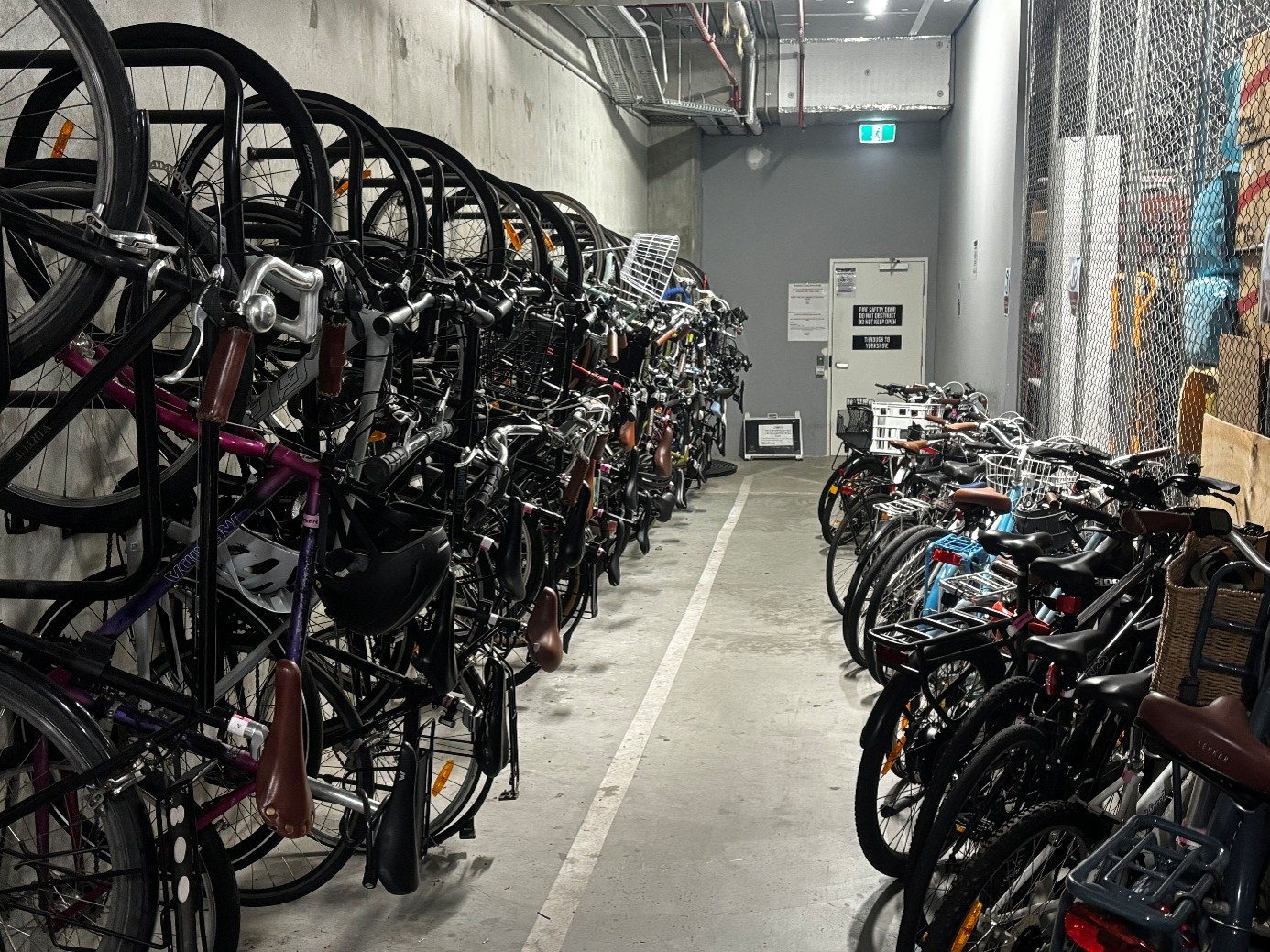
The above picture shows a popular bicycle parking facility which happens to be in my apartment building. Aside from the obvious under provision for standard bicycle parking, noting a minimum aisle width of 1.5 metres is not provided, non-standard bicycle parking is not provided at all. While people can get creative with maximising use of a space for standard bicycles (the right side of the image), this is not the case for eBikes (nowhere to be seen in the image). Without the ability to lift them an eBike would typically take up the space of three to four standard bicycles. This poses quite a problem for the users and other bike riders looking to store their bicycle.
What exactly do eBikes need in a bicycle parking facility?
- Larger spacing envelopes: cargo bikes can be up to 2.5 metres long.
- Wider aisles: due to their weight and reduced turning ability, manoeuvring eBikes is much more prohibitive.
- Increased minimum horizontal parking facilities: to support the increase in popularity of eBikes.
- Charging integration: Parking spaces with access to compliant charging zones.
- Enhanced security: Restricting access to eBike parking areas to reduce occurrences of theft.
When designing bicycle facilities it is therefore imperative to think outside of the existing recommendations of local government and the Australian Standard. The proportion of standard bike riders to eBike riders is shifting and good building design should account for this. This is definitely something I will promote when undertaking Traffic Impact Assessments for my clients to ensure my work stands the test of time (and that no one else needs to experience bicycle facilities like the one in my apartment building).